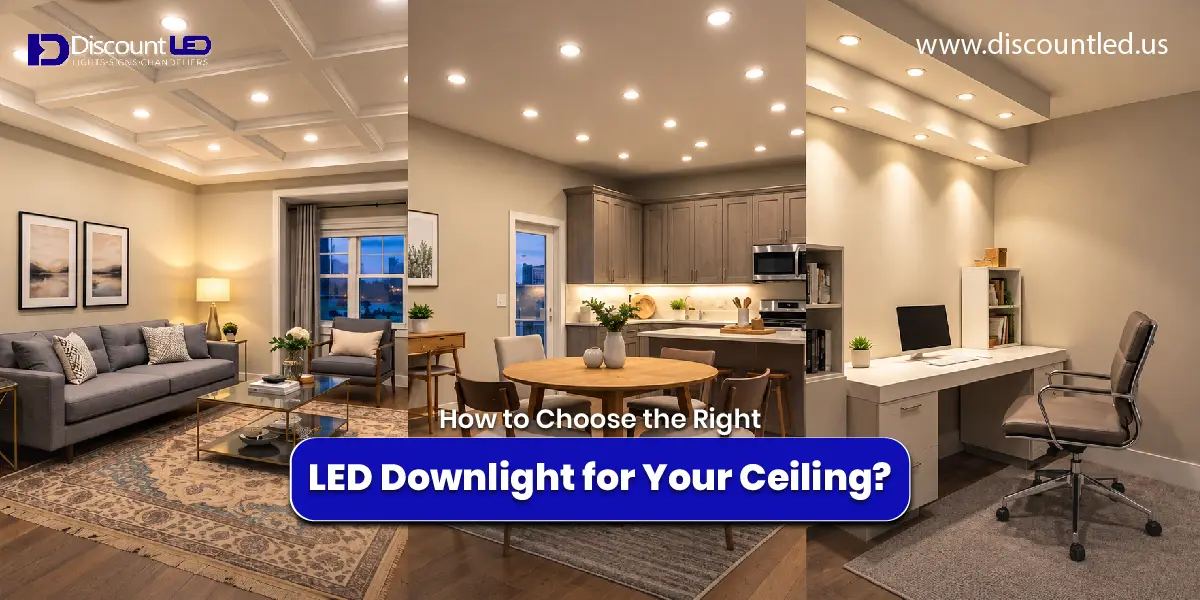
Ever wonder why one downlight makes a room feel comfortable while another creates glare or leaves dark spots? The answer often goes beyond wattage. LED downlights ceiling selection depends on the ceiling opening, room size, lumen output, beam angle, color temperature, and how the space will be used.
A fixture that works well in a bedroom may not be the right choice for an office, kitchen, retail store, or commercial space. At Discount LED, we offer recessed and low-profile LED lighting for residential and commercial applications.
In this guide, we’ll walk through the key factors to consider before choosing a downlight, from sizing and brightness to color temperature, spacing, dimming, and installation requirements.
How Do You Start Your LED Downlights Ceiling Selection?
Before comparing finishes or brands, inspect the ceiling and define what the fixture needs to accomplish. LED downlights ceiling selection becomes much simpler when you answer four questions: Are you replacing an existing fixture? What is the cutout size? How much light does the area need? Should the light cover a broad area or highlight a particular feature?
Measure the ceiling opening first. Discount LED’s current recessed range includes 4-inch, 6-inch, and 8-inch options, with 10W, 15W, and 30W models and multiple color-temperature choices. This is why fixture size and output should be considered together.
If you’re replacing an older fixture, matching the cutout can help avoid unnecessary ceiling repairs. For new installations, check the ceiling material, available space above the ceiling, and mounting method before ordering.
What Does the Ceiling Opening Tell You?
The cutout is one of the easiest details to overlook. A fixture that is too small can leave a visible gap, while one that is too large may not fit without modifying the ceiling. For an LED downlights ceiling layout, this measurement is the starting point for everything that follows.
Measure the opening rather than relying on the trim’s outside diameter. Then compare that measurement with the manufacturer’s required cutout. Also check ceiling thickness and mounting hardware. Discount LED’s recessed models use two clips to secure the fixture in the ceiling opening.
How Do Lumens and Wattage Affect Your Choice?
Wattage describes electrical power use; lumens describe light output. When comparing fixtures, start with lumens and then consider efficacy, which shows how much light a fixture produces for each watt of input.
ENERGY STAR’s current criteria for qualifying downlights require at least 82 lumens per watt, while minimum light-output requirements change according to aperture size. Two fixtures with the same wattage can therefore produce different amounts of light.
LED lights use up to 90% less energy and last up to 25 times longer than incandescent bulbs, and their costs have continued to decline. For a broader look at the business case, see the benefits of switching to LED lights for your business.
How Does Fixture Size Affect the Ceiling?
LED downlight size affects both fit and appearance. Match the fixture to the ceiling opening, then consider ceiling height, lumen output, beam distribution, and spacing.
A smaller aperture can look more discreet, while a larger fixture may provide stronger output.
Which Color Temperature Fits Your Room?
LED downlight ceiling color temperature changes the character of the room. Lower Kelvin values appear warmer, while higher values look cooler.
As a starting point:
- 2700K–3000K: Bedrooms, lounges, relaxed dining, and hospitality spaces
- 3500K–4000K: Offices, kitchens, corridors, retail, and general-purpose interiors
- 5000K and above: Task-focused or utility areas where cooler light is appropriate
ENERGY STAR describes 2700K–3000K as warmer light and 4000K or higher as cooler/bluer. ENERGY STAR: Keeping the color temperature consistent across an open area can also create a more cohesive appearance.
For a broader look at modern controls and lighting approaches, see these LED lighting trends.
How Does Beam Angle Change the Lighting Result?
LED downlight beam angle determines how broadly light spreads. A narrower distribution can highlight artwork, counters, shelving, or displays; a wider beam can cover more of a room.
Ceiling height and spacing also affect the result. For an LED downlights Ceiling plan, think about the illuminated surface rather than the fixture alone.
How Do Recessed Fixtures Compare With Other Indoor Options?
Recessed LED downlights sit within the ceiling and keep the fixture visually restrained. They work well when you want clean overhead illumination without a large surface-mounted body.
By contrast, LED ceiling lights can include panels, troffers, flush fixtures, and other designs that sit on or integrate differently with the ceiling. LED recessed lighting and other ceiling downlights can then be selected according to the ceiling system and room layout.
For offices with grid ceilings, panels or troffers may provide more practical coverage than individual recessed fixtures. Discount LED offers LED panel lights in 2×2 and 2×4 formats, while its LED troffer lights support recessed, suspended, and surface-mounted applications.
When Are Downlights Suitable for Commercial Spaces?
Commercial LED downlights can suit offices, retail stores, restaurants, hotels, healthcare facilities, and other interiors. For larger projects, consider how they work with panels, troffers, linear fixtures, and controls. An LED downlights ceiling layout can then use different fixtures where each area needs them.
What Should You Check for Dimming, Moisture, and Heat?
Check the installation environment before ordering. Bathrooms, kitchens, covered outdoor areas, and other moisture-prone locations may require an appropriate location rating. Don’t assume a standard indoor fixture is suitable for every ceiling.
If you need dimming, confirm that the fixture, driver, and dimmer are compatible. Dimming capability should be part of the selection process rather than something added after installation.
Heat management matters as well. LED products generate heat, so the housing and driver need an installation environment that follows the manufacturer’s requirements. Discount LED’s recessed downlights use aluminum alloy and PC housing designed to help with heat dissipation.
What Common Downlight Mistakes Should You Avoid?
A short checklist can prevent most selection problems:
- Measure the cutout before ordering.
- Compare lumens, not just watts.
- Match the CCT across the room or open area.
- Check beam distribution against ceiling height and purpose.
- Confirm dimming compatibility when required.
- Check location ratings for moisture-prone areas.
- Review certification and warranty for the exact model.
- Plan spacing around the room’s function, not only the ceiling grid.
If you’re planning a full lighting upgrade, these same principles can help you compare downlights with panels, tubes, high bays, and other fixtures.
Which Other Indoor Lighting Options Should You Consider?
Downlights are not the only option for indoor spaces. LED panels, troffers, tube lights, and LED strips can provide broader coverage or serve areas where recessed fixtures are not practical. For example, LED strips can add accent lighting beneath cabinets, along shelves, inside displays, or around architectural details.
If you’re planning a strip-light installation, this guide on how to connect and extend LED strip lights safely covers important considerations such as connections, power, and run length.
For projects that combine lighting with branding, illuminated features can also complement the main ceiling lighting. If you’re considering custom neon, this guide on how much neon signs cost explains the factors that can affect custom neon pricing. You can also compare LED vs. neon signs to understand the differences in construction, maintenance, energy use, and applications.
Final Thoughts
Choosing LED downlights ceiling fixtures comes down to fit, output, distribution, color, and installation conditions. Measure the opening first, compare lumens, select the right color temperature, and match the beam to the room.
Then check dimming, location rating, certification, and warranty. Discount LED offers recessed options alongside panels, troffers, tubes, strips, and other lighting products for Dallas-area projects.
Frequently Asked Questions
Match the fixture’s required cutout to the existing opening or planned installation. Room dimensions, ceiling height, lumen output, and the desired visual scale should also influence the choice.
Yes, they can be suitable for offices where a low-profile ceiling appearance is desired. For larger grid-ceiling offices, panels or troffers may provide broader coverage.
Not always. If adjustable brightness is part of the lighting plan, select a dimmable fixture and confirm that the driver and dimmer are compatible.
Lifespan varies by product and operating conditions. Check the manufacturer’s rated life for the exact fixture rather than assuming all LED products have the same service life. LEDs generally have a much longer rated life than incandescent lighting.