Dallas-Fort Worth is becoming an even bigger market for data centers, AI infrastructure, and cloud computing. CBRE reported that DFW reached 1,249.4 MW of data center inventory in Q1 2026, up 43.7% year over year, while vacancy fell to 1.8%. More than 716 MW was under construction, with 88% already preleased.
That growth puts more attention on every part of a facility’s operation, including lighting. Data center LED lighting Dallas businesses need should provide clear visibility around racks, cable trays, access areas, and maintenance zones while keeping energy use under control and working properly with other building systems.
According to DiscountLED, for a data center, lighting is not simply about making a room bright. Fixture placement, uniformity, controls, emergency lighting, heat management, and maintenance access all need to work together. So, learn what should businesses actually look for when choosing lighting for a data center or server room?
Why Do Data Center LED Lighting Dallas Facilities Need Differently Designed Fixtures?
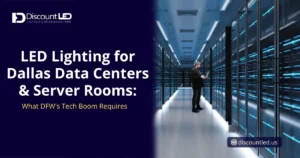
Data center LED lighting Dallas facilities use has a different job from lighting in a typical office or retail building. Technicians need to read labels, identify ports, inspect cables, move equipment, and work safely around dense infrastructure.
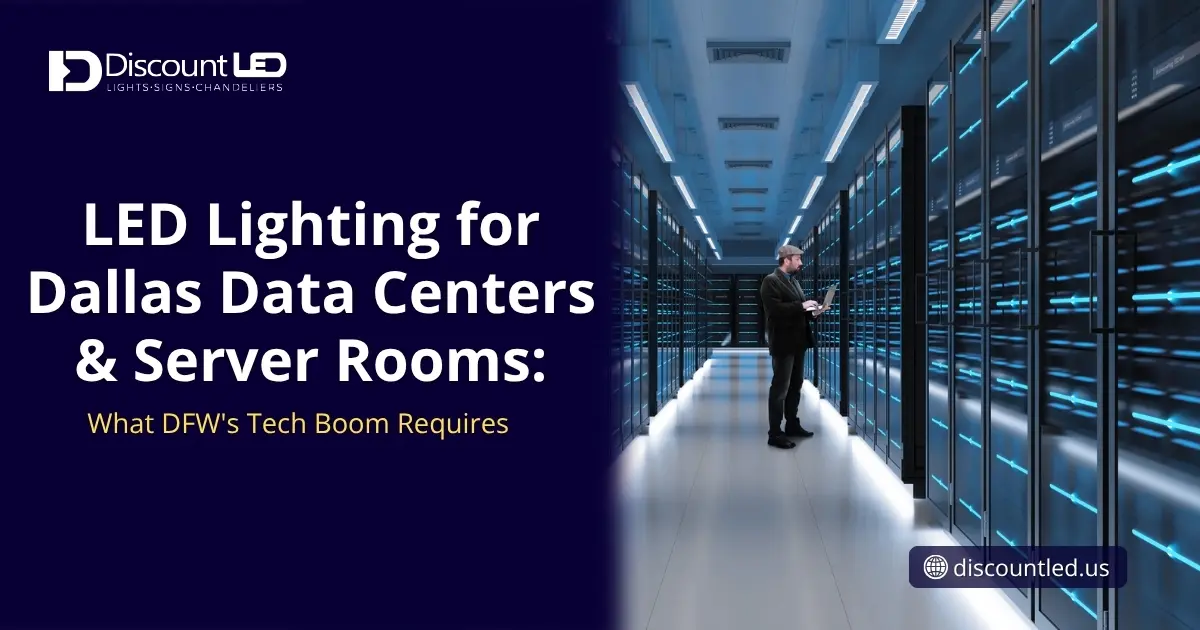
ASHRAE recommends placing fixtures over aisles rather than directly over cabinets or cable trays, where light can be wasted. Its guidance also identifies about 325 lux on the vertical surfaces of cabinets as generally sufficient and recommends proximity sensors so lights are not left on when areas are unoccupied.
That makes fixture distribution more important than simply choosing the highest-lumen product.
How Much Light Does a Server Room Actually Need?
No one light level works for every server room. The right amount depends on rack layout, ceiling height, aisle width, maintenance work, and how the space is used.
Technicians need enough light to read equipment labels, trace cables, inspect connections, and work safely. For that reason, vertical visibility at the rack face can be just as important as how bright the floor looks.
A good lighting plan should consider:
- Rack and aisle layout
- Fixture spacing
- Mounting height
- Light distribution
- Vertical illumination
- Glare and shadows
- Emergency lighting
- Cable trays and other obstructions
For a data center lighting spec, focus on how the light reaches the equipment and work areas rather than choosing fixtures based only on wattage or total lumens. DOE guidance also recommends evaluating LED fixtures by light output, efficacy, and application rather than relying on wattage only.
How Can LED Lighting Reduce Data Center Energy Waste?
Lighting is not the largest electrical load in a data center. Servers, cooling systems, UPS equipment, and other infrastructure consume far more energy.
That does not make lighting irrelevant.
Data centers operate continuously, so even a relatively small lighting load can accumulate over thousands of operating hours. LED fixtures can reduce the lighting load compared with older technologies, while controls can prevent fixtures from operating unnecessarily.
LED lighting can reduce energy consumption and bills substantially compared with traditional fluorescent and halogen technologies, while longer service life can reduce replacement requirements. The bigger opportunity comes from combining efficient fixtures with occupancy controls.
Can Occupancy Sensors Make Server Room Lighting More Efficient?
Yes. Server room LED lights DFW facilities use can benefit from occupancy sensors, especially in areas that technicians visit only for inspection or service. Sensors can reduce lighting when these spaces are empty.
Controls can be set around the facility’s normal activity:
- Occupied: Normal lighting for maintenance and service work.
- Temporarily unoccupied: Lighting dims to a lower level.
- Extended vacancy: Nonessential lighting can switch off or remain at a low setting.
- Emergency: Required emergency lighting remains available.
When properly configured, occupancy controls can reduce unnecessary lighting use without leaving technicians working in dark aisles.
How Does Fixture Placement Affect Server Rack Visibility?
Placement is one of the most overlooked parts of data center lighting.
Putting fixtures directly over racks can waste light because equipment cabinets and cable trays block part of the output. Fixtures centered over aisles can deliver more useful illumination to the equipment fronts.
It is recommended to position fixtures over aisles, and mounting around 2.44 to 2.75 meters above the floor can help direct light toward technicians and cabinet faces.
The layout should also account for future changes. Data centers are frequently modified as racks, cable pathways, cooling equipment, and other infrastructure are added.
A lighting system that works today should not become a maintenance problem after the next expansion.
What Color Temperature Works Best in Data Centers?
Color temperature should support visual clarity without creating an unnecessarily harsh environment.
Neutral to cool white LED lighting is commonly considered for technical spaces because it provides a crisp appearance and can make equipment labels and work surfaces easier to distinguish.
However, color temperature should be selected alongside color rendering, glare control, fixture optics, and the tasks performed in the room.
There is no universal requirement that every data center use one specific Kelvin value. The lighting designer should select the combination that provides comfortable and accurate visibility for technicians.
If you also want to learn about the color rendering concept, it’s simple: how faithfully a light source reveals the colors of objects compared to a natural light source, like sunlight. For more details on it, you can read the complete guide on the colour rendering index.
Can Smart Controls Work With Data Center Lighting?
Yes. Data centers can use occupancy sensors, dimming, low-voltage controls, and networked lighting systems.
It is said that 0 to 10 V and Power over Ethernet controls are suitable options for data center lighting. It also notes that PoE lighting can provide centralized monitoring of lighting and energy use.
This creates opportunities for facility managers to control lighting by zone rather than treating an entire server room as one electrical circuit.
A connected system can also make troubleshooting easier. If a lighting zone stops responding or operates outside its schedule, facility personnel may be able to identify the issue without walking through every aisle.
What Makes Commercial LED Data Center Texas Projects Different?
A commercial LED data center Texas project needs to consider more than fixture efficiency.
The facility may have:
- High equipment density
- Restricted maintenance access
- Raised floors
- Cable trays
- Overhead cooling systems
- Emergency power
- Security requirements
- Continuous operation
- Strict maintenance procedures
The lighting design therefore needs to fit the facility’s mechanical and electrical infrastructure.
How Does DFW’s Data Center Growth Affect Lighting Requirements?
The scale of DFW’s data center market makes efficient facility design increasingly important.
According to the reports, DFW became the third-largest North American data center market in Q1 2026, with inventory increasing by 379.9 MW year over year. The report also points to strong demand from hyperscalers, AI companies, and enterprises.
The Dallas Federal Reserve has also highlighted the broader electricity implications of rapid data center growth, noting that rising data center demand is creating additional pressure on the electric grid.
That makes energy efficiency relevant at every level. Lighting is only one component, but it is one of the components that can be controlled, scheduled, and upgraded without changing the computing infrastructure itself.
What LED Fixtures Work Well in Data Centers?
The right fixture depends on the room.
- Linear LED fixtures can work well in long equipment aisles where even distribution is important.
- LED panels may be appropriate for offices, monitoring rooms, break rooms, and administrative areas connected to the facility.
- High bay lighting can be useful in warehouses, staging areas, and high-ceiling support spaces rather than dense server aisles.
For businesses evaluating broader commercial lighting upgrades, high bay LED lighting can be considered for warehouse and industrial areas where ceiling height and coverage requirements differ from server rooms.
The fixture should always be selected around the actual application rather than using the same product throughout the entire facility.
What Should Dallas Data Center Operators Check Before an LED Upgrade?
Before replacing an existing system, document the current facility.
Check:
- Current fixture type and wattage
- Existing illumination levels
- Rack and aisle configuration
- Ceiling and mounting conditions
- Operating hours
- Areas with limited occupancy
- Emergency lighting requirements
- Existing controls
- Maintenance access
- Planned expansion
A lighting audit can then identify where the largest improvements are possible.
Discount LED’s Dallas warehouse LED lighting case study provides an example of how an existing commercial facility can be evaluated around visibility, energy use, maintenance, and fixture selection. In that project, the team used linear high bays for long aisles and UFO fixtures for more open areas.
Conclusion
DFW’s expanding data center market is making efficient facility design more important than ever. Data center LED lighting Dallas operators choose should provide clear visibility around equipment while supporting energy management, maintenance, and safe movement through the facility.
The best solution is not simply the fixture with the highest output or lowest wattage. Rack layout, vertical illumination, controls, emergency lighting, mounting, and future expansion all matter. For auxiliary areas or accent applications using LED strips, proper connection and extension of LED strip lights is also important for safe, reliable performance.
For Dallas data centers and server rooms, a proper lighting assessment can identify where LED upgrades, sensors, dimming, and better fixture placement can make the biggest difference. As facilities become larger and more power-intensive, even smaller operational improvements deserve careful planning.
Frequently Asked Questions
A: LED fixtures with controlled distribution, good vertical illumination, reliable operation, and suitable occupancy controls are generally well suited to data center environments.
A: Data center’s guidance identifies about 325 lux on vertical cabinet surfaces as generally sufficient for datacom rooms, though project requirements can vary.
Yes. Proximity or occupancy sensors can reduce lighting in unoccupied aisles and areas, provided the controls are properly designed for technician activity and safety.
A lighting plan should consider fixture layout, vertical illumination, light levels, glare, controls, emergency lighting, mounting, maintenance access, and future rack or infrastructure changes.