Have you ever walked into an office where the ceiling lights technically work, but the room still feels dull, uneven, or dated?
The fixture itself may be part of the problem. When businesses compare LED panels vs troffer lights, the choice is not simply about which fixture looks newer. It depends on the ceiling, the existing layout, how the room is used, how much light is actually needed, and how much work the replacement will involve.
A flat panel can give a space a cleaner look. A troffer may make more sense when the building already has a traditional recessed ceiling grid. The right answer starts with the room, not the product name.
How Should You Compare LED Panels vs Troffer Lights?
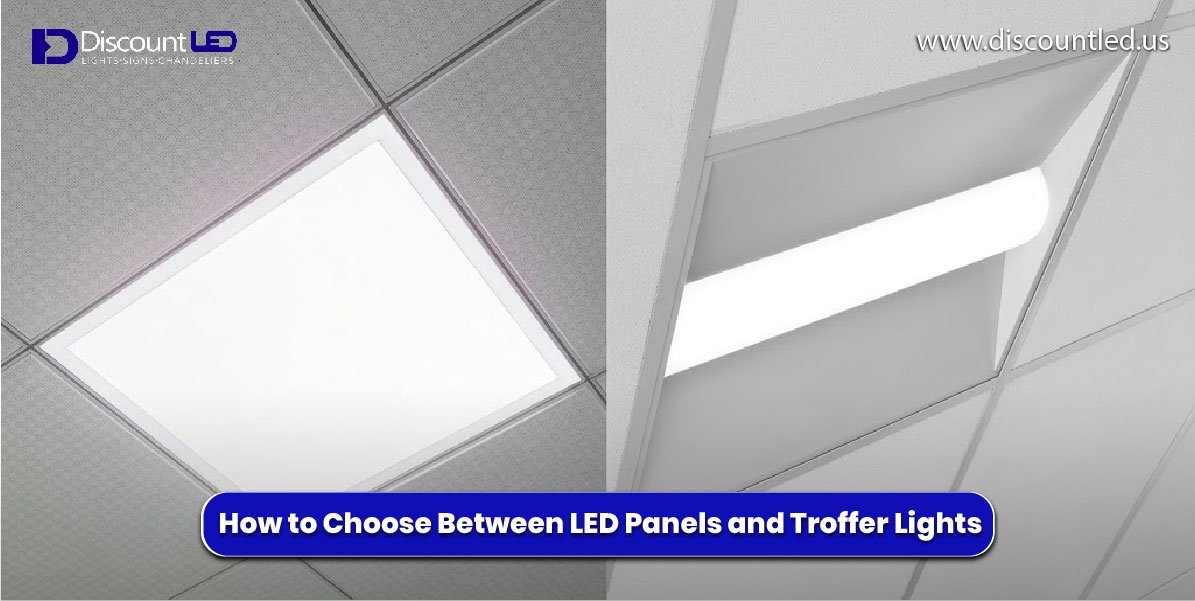
The practical difference between LED panels vs troffer lights is mostly about fixture design and how they fit into the ceiling.
A panel usually has a slim body and a broad illuminated surface. A troffer follows the familiar recessed fixture format commonly found in offices, classrooms, hospitals, and other commercial buildings.
The terminology is not always perfectly separated. Some manufacturers even describe certain products as panel troffers, which is why specifications matter more than labels.
| What to Compare | LED Panel | LED Troffer |
|---|---|---|
| Appearance | Flat and minimal | More traditional recessed fixture |
| Common use | Offices, schools, retail, healthcare | Offices, schools, existing fluorescent layouts |
| Ceiling fit | Common in 2×2 and 2×4 grids | Common in 1×4, 2×2 and 2×4 grids |
| Light appearance | Broad, even surface | Depends more on fixture optics and design |
| Retrofit use | Good when replacing the full fixture | Often practical in existing troffer locations |
DiscountLED carries both LED panel lights and LED troffer lights, so it makes more sense to compare the actual wattage, lumens, dimensions, controls, and installation needs than to choose by category name alone.
When Do LED Panels Make More Sense?
Panels work well when the ceiling is part of the visual design of the room. In a renovated office, clinic, classroom, or retail space, LED panel lights can create a flatter and less cluttered ceiling. They are especially useful when the goal is broad, even illumination without a deep-looking fixture.
For office LED lighting, that cleaner appearance can make a noticeable difference in meeting rooms, open offices, reception areas, and workspaces where people spend most of the day. Recessed LED panels can also fit standard ceiling grids when the dimensions and installation method match the existing system.
Panels are usually worth considering when:
- You want a simple, flat ceiling appearance
- The room needs broad, even light
- The existing grid supports the panel size
- You are already replacing the complete fixture
- Dimming or lighting controls are part of the project
If the ceiling uses round cutouts rather than a grid, panels may not be the right product at all. DiscountLED’s guide to choosing the right LED downlight for your ceiling covers that type of installation.
When Are Troffers the More Practical Choice?
Troffers often make sense in buildings that already have rows of recessed fluorescent fixtures. Instead of redesigning the ceiling layout, the new lighting can often follow the same fixture positions. That can be useful in offices, schools, medical facilities, and other commercial spaces where the grid is already established.
The U.S. Department of Energy describes troffers as rectangular luminaires commonly used in modular dropped ceilings. Depending on the condition of the existing fixture, a retrofit may involve LED tubes, retrofit kits, or complete fixture replacement.
That is why troffer lighting is still widely used even as newer fixture styles become available. If the building still has fluorescent T8 lamps, replacing the complete fixture is not always the only option. DiscountLED’s T8 LED tube vs fluorescent retrofit guide explains when a lamp retrofit may be worth considering.
The LED panel vs troffer decision becomes much easier once you know whether the project is a simple lighting upgrade or a larger ceiling renovation.
Which Fixture Gives You Better Light?
There is no automatic winner in LED panels vs troffer lights. A well-designed troffer can outperform a poorly selected panel, and the reverse is also true. What matters is how much usable light reaches the room and how comfortably it is distributed.
For commercial ceiling lights, compare:
- Lumens
- Input wattage
- Lumens per watt
- Color temperature
- CRI
- Dimming capability
- Beam and light distribution
- Glare
- Controls
- Warranty
Do not choose by wattage alone. For example, a higher-wattage fixture may simply be designed for a higher lumen package. That does not make it the better choice for every office. A conference room, hallway, classroom, and open workspace may all need different light levels.
How Much Do the Existing Ceiling and Installation Affect the Choice?
Existing ceiling and installation affect the choice alot. This is where panel lights vs troffers often stops being a design question and becomes a practical construction decision.
Before ordering fixtures, check:
- Ceiling grid dimensions
- Available space above the ceiling
- Existing fixture size
- Wiring and driver access
- Emergency-lighting requirements
- Control compatibility
- Required light levels
- Labor involved in removing the existing fixtures
A panel that costs slightly less may not save money if installation requires additional ceiling work. A troffer may be a better value when it fits the existing opening with less modification.
Controls are also necessary. Occupancy sensors, scheduling, daylight response, and dimming can reduce unnecessary operating hours. DiscountLED’s guide to smart LED lighting in Dallas explains how those controls can fit into a larger lighting upgrade.
How Should Panels and Troffers Fit Into a Larger Lighting Project?
Most commercial properties need more than one fixture type. A building might use panels or troffers for office ceiling lights, high bays in a warehouse, wall packs outside, and pole lights in the parking lot. Each area should be selected around its own mounting height, activity, operating hours, and visibility needs.
That is why a commercial LED lighting plan should divide the property into zones instead of trying to use the same fixture everywhere.
For exterior areas, DiscountLED’s LED parking lot lighting guide covers pole-mounted lighting, while its guide to outdoor LED storefront lighting focuses on building exteriors and storefront visibility.
Businesses planning a wider retrofit can also review why Dallas businesses are switching to LED lighting and these energy-saving lighting tips for additional efficiency considerations.
Which Fixture Should You Choose for Your Space?
For most projects, LED panels vs troffer lights comes down to three things: what is already in the ceiling, how you want the room to look, and how much installation work makes sense. Choose a panel when you want a slim appearance, broad illumination, and a clean ceiling layout.
Choose a troffer when you already have a traditional recessed grid, want to keep existing fixture locations, or need a fixture that fits naturally into an established commercial ceiling. Neither option is automatically better.
The better fixture is the one that provides the right light level, works with the ceiling, supports the controls you need, and can be installed without unnecessary work.
Not sure which fixture fits your building? Send DiscountLED your room dimensions, ceiling type, existing fixture photos, fixture count, and current wattage. The team can compare suitable panel and troffer options and prepare a project-specific estimate.
Conclusion
Choosing a commercial ceiling fixture should not come down to which product looks newer on a specification sheet. Panels can be a great fit for clean, modern interiors, while troffers remain practical for many existing ceiling grids and retrofit projects.
When comparing LED panels vs troffer lights, look at the ceiling first, then compare lumen output, light distribution, controls, installation work, and total project cost. A fixture that fits the room properly will usually be a better investment than one chosen only because of its wattage, appearance, or product category.
FAQs
Can You Replace an Existing Troffer With an LED Panel?
Often, yes. The panel needs to match the ceiling-grid dimensions, electrical requirements, and installation method. Check the existing opening before ordering.
Are LED Panels More Energy Efficient Than Troffers?
Not automatically. Efficiency depends on the specific fixture’s wattage and lumen output. Compare lumens per watt between products designed for similar applications.
Which Fixture Is Better for an Office?
Both can work well. Panels are often chosen for a flatter, cleaner ceiling appearance, while troffers can be convenient when an office already has a recessed troffer layout.
Can Panels and Troffers Be Dimmed?
Yes, if the fixture driver supports dimming and is compatible with the control system being used. Always check the product specifications first.
Do You Have to Replace an Entire Fluorescent Troffer?
Not always. Depending on the condition of the existing fixture, LED tubes or retrofit kits may be possible alternatives to full fixture replacement.