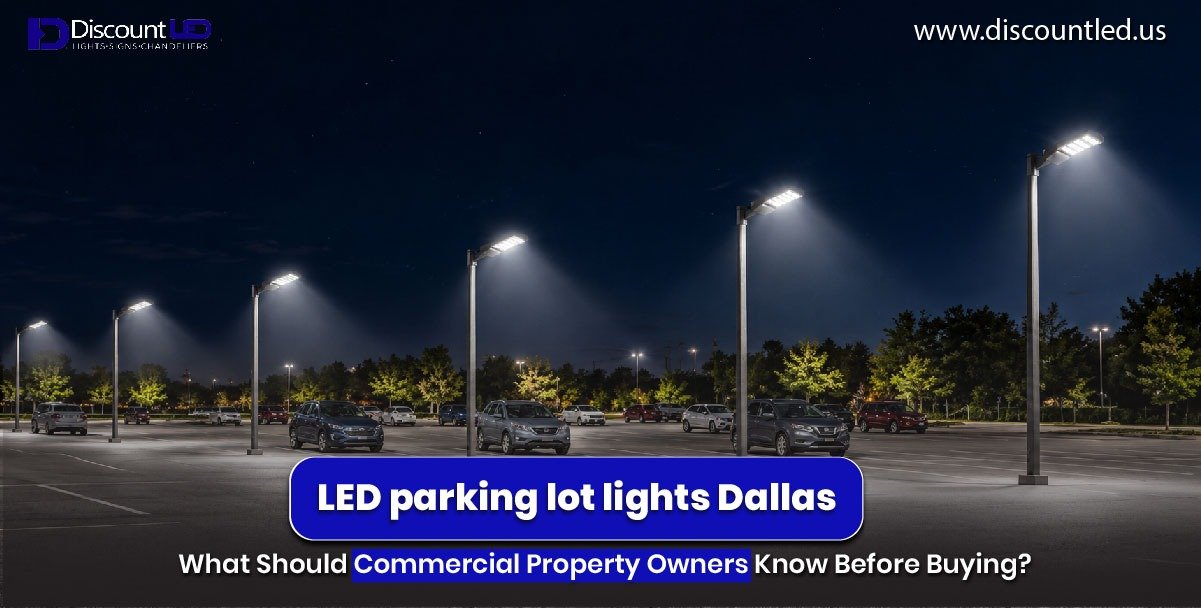
A parking lot can look bright and still perform poorly. One pole may create a harsh hotspot while the next row falls into shadow, and a high-wattage fixture can still waste light outside the usable area.
For property managers and commercial real estate owners comparing LED parking lot lights Dallas options, the right buying decision starts with the site: pole height, spacing, optics, operating hours, controls, electrical conditions, and nearby properties.
The goal is not simply to buy a brighter fixture. It is to create even, reliable, energy-efficient lighting that supports visibility, reduces maintenance, and fits the property’s nighttime use. Read the guide till the end to learn about LED parking lot lights Dallas and what should commercial property owners know before buying.
How Should Property Managers Choose LED parking lot lights Dallas Properties Actually Need?
LED parking lot fixtures are usually pole-mounted area lights used across parking stalls, drive aisles, entrances, pedestrian routes, and perimeter zones. They are also called shoebox lights, area lights, parking lot pole lights, or commercial outdoor area lights.
For LED parking lot lights Dallas projects, review four factors together: mounting height, pole spacing, lumen output, and optical distribution. Changing one affects how light reaches the pavement. That is why replacing an old metal halide fixture with an LED based only on wattage can produce uneven results.
Before requesting a quote, document:
- Pole count and approximate height
- Distance between poles
- Number of fixtures per pole
- Existing wattage and voltage, if known
- Arm or tenon mounting style
- Operating hours
- Dark spots, glare complaints, or nearby residential areas
For buyers comparing commercial outdoor LED Dallas products, these site details are more useful than a simple “higher watts means more light” rule.
Why Do Optics and Photometrics Matter?
Two fixtures with similar lumen output can perform very differently because their optics distribute light differently. A perimeter pole needs more forward throw, while a central pole needs broader coverage.
For larger lots, dealerships, retail centers, hotels, warehouses, and medical properties, a photometric plan can show expected light levels, dark areas, uniformity, and spill before installation.
Which Specifications Matter Most When Comparing Commercial Parking Lot Lights?
A commercial fixture should be evaluated as a complete system. Compare:
- Delivered lumens and efficacy
- Optical distribution
- Input voltage
- Dimming and sensor compatibility
- IP or wet-location rating
- Surge protection
- Safety and efficiency certifications
- Warranty coverage
- Mounting compatibility
For LED parking lot lights Dallas procurement, ask for the exact fixture SKU rather than accepting a description such as “200W LED shoebox.” The model number lets you verify output, voltage, CCT, optics, certifications, and warranty before purchase.
UL or ETL listings, DLC qualification, IP ratings, and warranties answer different questions. One should not replace another. If utility rebates are necessary, verify eligibility for the exact SKU.
If the same property is upgrading interior fixtures, keep that scope separate. DiscountLED’s T8 LED tube vs fluorescent office retrofit guide explains why interior retrofit decisions differ from outdoor pole lighting.
When Does a Retrofit Make More Sense Than Replacing Existing Poles?
A retrofit usually makes sense when the existing poles are structurally sound, their locations still work, the circuits are usable, and new fixtures can mount correctly.
A larger redesign might be justified when poles are damaged, the lot has changed, new pedestrian routes were added, or poor pole spacing creates unavoidable dark zones.
For multi-site owners comparing parking lot lighting DFW projects, use one survey template for every location. Consistent site data makes bids easier to compare and reduces change orders.
Controls can also improve a retrofit. Photocells, schedules, bi-level dimming, occupancy sensors, and networked controls can reduce unnecessary operating hours. DiscountLED’s guide to smart LED lighting in Dallas covers those strategies, while LED lighting trends for 2025 provides additional background on connected and adaptive lighting.
What Dallas Permit, Light-Level, and Glare Rules Should Owners Check?
Commercial electrical work in Dallas generally requires a registered electrical contractor and an electrical permit. The City of Dallas electrical permit checklist also identifies information that is required when electrical plans are submitted.
The Dallas Development Code includes off-street parking lighting requirements that can address minimum light levels, glare control, shielding, and spillover toward residential property. The applicable standard can vary by parking use, zoning district, or planned development conditions.
That means LED parking lot lights Dallas compliance is not determined by the fixture label alone. A listed product can still be installed in a layout that does not meet the site requirements.
Before approving the design, confirm:
- Applicable Dallas zoning requirements
- Required initial and maintained light levels
- Property-line spill limits
- Shielding or glare-control requirements
- Permit and inspection responsibilities
- Whether poles, circuits, or the site layout are changing
A photometric plan should also be checked for minimum points, uniformity, property-line spill, fixture orientation, mounting height, and exact fixture models. A high average footcandle number does not automatically mean a well-designed lot.
How Should Owners Compare Energy Savings and Total Project Cost?
The cheapest fixture is not always the lowest-cost solution. Property managers should compare total cost of ownership, including fixture cost, installation, lift equipment, permits, annual energy use, controls, maintenance, warranty logistics, and future replacement compatibility.
A simple energy baseline is:
Annual kWh = total fixture watts × annual operating hours ÷ 1,000
Then calculate the proposed system the same way. If fixtures dim for part of the night, model those hours separately.
DiscountLED’s article on why Dallas businesses are switching to LED lighting adds useful context on energy use, maintenance, and commercial operating costs.
Parking lot lighting should also be coordinated with the rest of the exterior. Main parking fields may use area lights, while building perimeters need wall packs and loading areas need flood lighting. The guide to outdoor LED lighting for Dallas storefronts explains how storefront lighting fits into the wider exterior plan.
For retail properties, keep permanent site lighting separate from temporary marketing graphics. Seasonal signage can change without changing the base lighting system; the Halloween storefront sign ideas guide is one example.
What Should Property Managers Ask Before Approving a Vendor Quote?
A strong vendor should explain why a specific fixture fits the site rather than simply quote a price per unit. Ask for the exact SKU, wattage, lumen output, optic, CCT, voltage, mounting method, control strategy, surge protection, certifications, warranty coverage, permit responsibility, installation scope, and exclusions.
For buyers researching pole lights Dallas TX, supplier capability matters because the project involves more than the fixture itself. DiscountLED’s guide to choosing a Dallas lighting store offers a useful framework for comparing technical support, product range, local availability, and project experience.
For an accurate quote, provide the property address, pole count, approximate heights, current fixture photos, existing wattage, operating hours, voltage if known, problem areas, desired controls, and project schedule.
Managing one commercial property or a multi-site portfolio? Send Discount LED your site information and request a project-specific lighting proposal covering fixture selection, controls, installation, and permit needs,not just a generic per-fixture price.
Conclusion
A successful parking lot upgrade starts with the property, not a wattage chart. Review pole height, spacing, optics, photometric performance, electrical conditions, controls, Dallas requirements, warranty coverage, and lifecycle cost before approving the fixture schedule.
For property managers and commercial real estate owners, the right LED parking lot lights Dallas solution should deliver even illumination, reduce unnecessary energy use, lower maintenance risk, and fit how the property operates after dark. Define the site first, verify the lighting plan second, and buy the fixtures only after those two pieces are clear.
FAQs
How Many Watts Should an LED Parking Lot Light Be?
There is no universal wattage. The correct choice depends on pole height, spacing, lumen output, optic, site dimensions, and required lighting performance.
Are Shoebox Lights the Same as Parking Lot Lights?
Shoebox lights are a common type of pole-mounted area light used in parking lots. Output, optics, mounting, voltage, controls, and fixture quality determine whether a model fits the site.
Does a Dallas Commercial Parking Lot Retrofit Need a Permit?
Commercial electrical work in Dallas generally requires a registered electrical contractor and a permit. Exact requirements depend on the project scope.
Can Existing Parking Lot Poles Be Reused?
Often, yes. Existing poles can remain when their structure, bases, wiring, mounting hardware, and locations are suitable for the new fixtures.
What Is the Biggest Buying Mistake?
Buying by wattage or fixture price alone. Compare site performance, optics, uniformity, glare control, mounting height, controls, warranty, and installation requirements.