Dallas is a city that knows how to make an impression. From a glowing red horse above downtown to illuminated skyscrapers, historic theater marquees, colorful entertainment districts and massive digital displays, the city’s visual identity is hard to separate from its signs and landmarks.
Some have been part of the Dallas skyline for generations. Others represent a newer side of the city, where LED technology, digital displays, public art and architecture come together.
For anyone interested in iconic signs in Dallas, local history, architecture or memorable places to photograph, these landmarks offer a fascinating look at how visual identity shapes a city.
They also demonstrate something businesses have understood for decades: when a sign, symbol or building is distinctive enough, people remember it.
Here are 10 of the most iconic signs and landmarks in Dallas and what makes each one memorable.
The Pegasus Sign
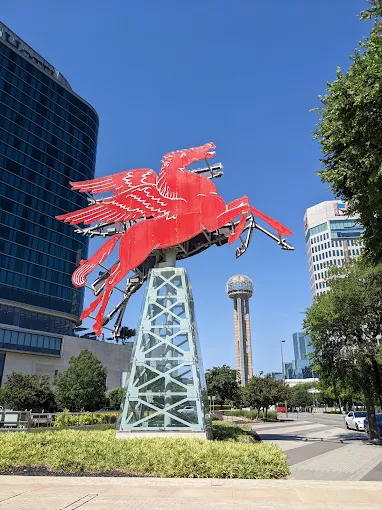
Few images are as closely associated with Dallas as the glowing red Pegasus.
The original Pegasus sign was installed atop the Magnolia Petroleum Building in downtown Dallas in 1934. According to Downtown Dallas Parks Conservancy, the flying horse originally appeared above what was then the city’s tallest building and was created in connection with the American Petroleum Institute’s annual meeting.
What began as corporate identification gradually became something much bigger: a recognizable symbol of Dallas itself.
The original sign was made of porcelain and neon. After decades of exposure to Texas weather, it was eventually removed. A replacement was illuminated atop the building at the beginning of 2000, while the original Pegasus was later restored and installed near the Omni Dallas Hotel.
What makes the Pegasus sign so memorable?
It has several qualities that still matter in effective signage:
- A simple silhouette
- A distinctive color
- Strong nighttime visibility
- A recognizable symbol
- Placement high above its surroundings
- Consistent visual identity
The Pegasus demonstrates how a sign can move beyond identification and become part of the identity of a place.
Modern businesses obviously do not need a 40-foot flying horse to achieve recognition. The principle is the same, though. Effective commercial building signs use scale, placement, illumination and brand consistency to help a business become easier to recognize.
The Majestic Theatre
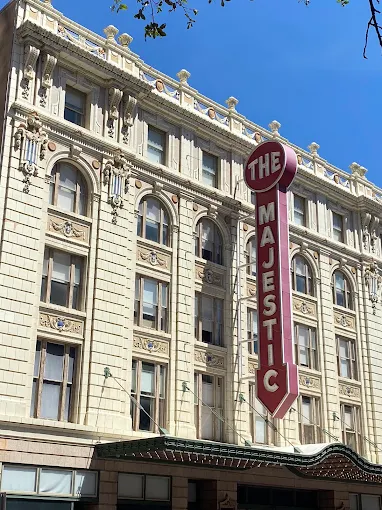
The Majestic Theatre is another Dallas landmark where architecture and signage work together.
The current Majestic opened in 1921 as a vaudeville theater. Designed by prominent theater architect John Eberson, it later transitioned into a movie theater before eventually becoming the performing arts venue it is today.
Its marquee is especially relevant to Dallas sign history.
City archive records note that in 1948 the Majestic’s marquee was changed toward a more Art Deco appearance, including flashing neon lights against a geometric background. The theater was later listed on the National Register of Historic Places in 1977.
The combination of lettering, illumination and architecture made the entrance itself part of the experience.
That idea remains relevant to modern storefront signs in Dallas. A sign does more than tell customers the name of a business. It can establish expectations before someone ever walks through the door.
Restaurants, theaters, retail stores, salons and entertainment venues often use illuminated lettering, cabinet signs or channel letter signs to create the same basic effect: making the entrance recognizable after dark.
Reunion Tower
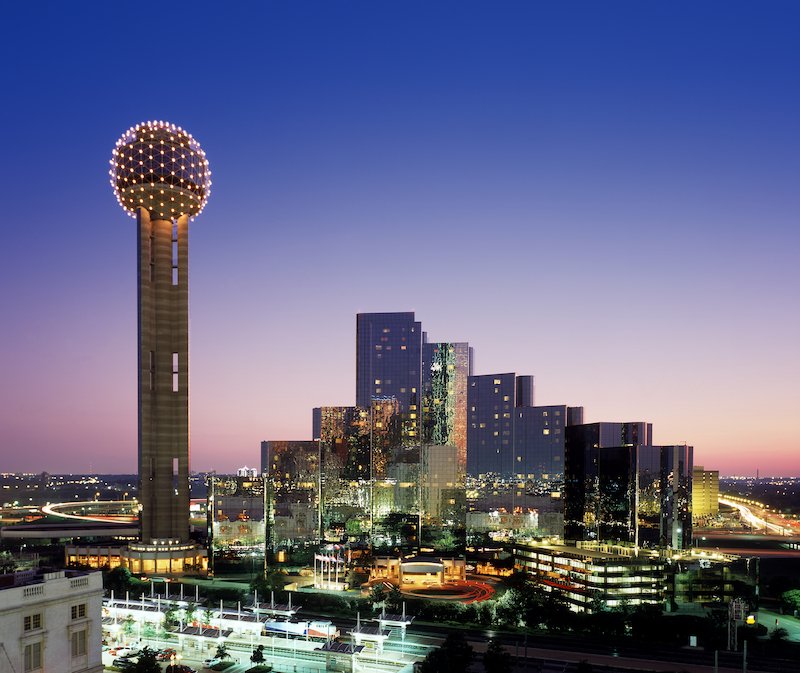
Some landmarks become recognizable without displaying a business name at all.
Reunion Tower is a perfect example.
The structure has been part of the Dallas skyline since 1978. Today, its spherical exterior uses 259 LED lights, making the tower visible from miles away. Its observation deck provides 360-degree views from 470 feet above the city.
At night, lighting transforms the structure from architecture into a visual beacon.
That illustrates an important distinction between traditional signage and architectural lighting. Sometimes recognition comes from letters or logos. In other cases, a building itself becomes the recognizable visual element.
Businesses use a smaller version of this principle through façade lighting, illuminated architectural features, accent lighting and exterior LED systems.
The objective is similar: create something people can recognize from a distance, particularly after dark.
The Giant Eyeball
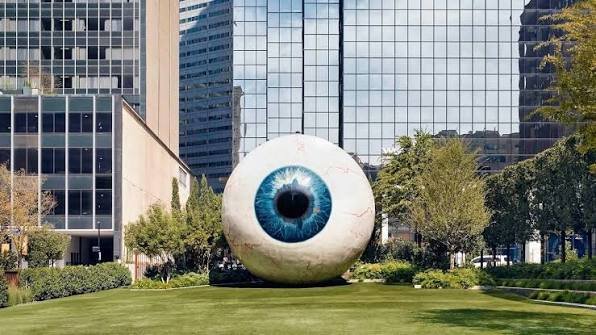
Not every landmark needs lights or giant lettering to be unforgettable.
Sometimes being unusual is enough.
The Eye, located on Main Street near The Joule, is a 30-foot-tall sculpture made from fiberglass, resin and steel. Artist Tony Tasset modeled the enormous sculpture after his own eye. It debuted in Chicago in 2010 before arriving in Dallas three years later.
It has since become one of downtown Dallas’ most recognizable pieces of public art.
Its marketing lesson is simple: distinctiveness creates memory.
For businesses, the same principle applies to visual branding. A generic storefront can disappear among neighboring businesses. A distinctive logo, color system, dimensional feature, illuminated sign or branded environment gives customers something visual to remember.
That does not mean every business should be outrageous. It means the design should contain something unmistakably its own.
Dallas Farmers Market
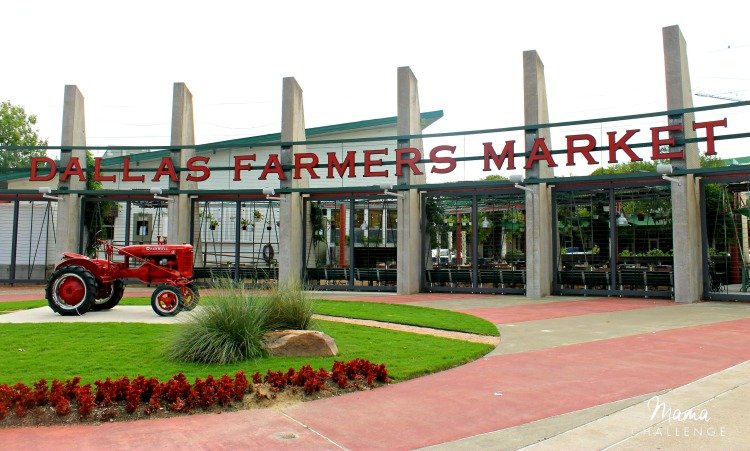
The Dallas Farmers Market represents a different kind of visual identity.
Its history stretches back to farmers selling produce from wagons in Dallas during the late 19th century. The current site developed over time, and by 1941 it was officially operating as a municipally owned and operated market. Today, the market says it is home to more than 200 small businesses and supports more than 50 Texas farmers and ranches throughout the year.
Unlike a single landmark sign, a market environment needs layers of visual communication.
Visitors need to understand:
- Where to enter
- Where individual vendors are located
- What each business sells
- Where facilities are located
- How to navigate the property
- Which storefront belongs to which brand
This is where retail signs, storefront signs, directional signs and informational signage work together.
The Dallas Farmers Market is a useful reminder that successful commercial signage is not always one giant sign. Sometimes it is an entire visual system that helps people navigate a destination while allowing individual businesses to maintain their own identity.
Deep Ellum
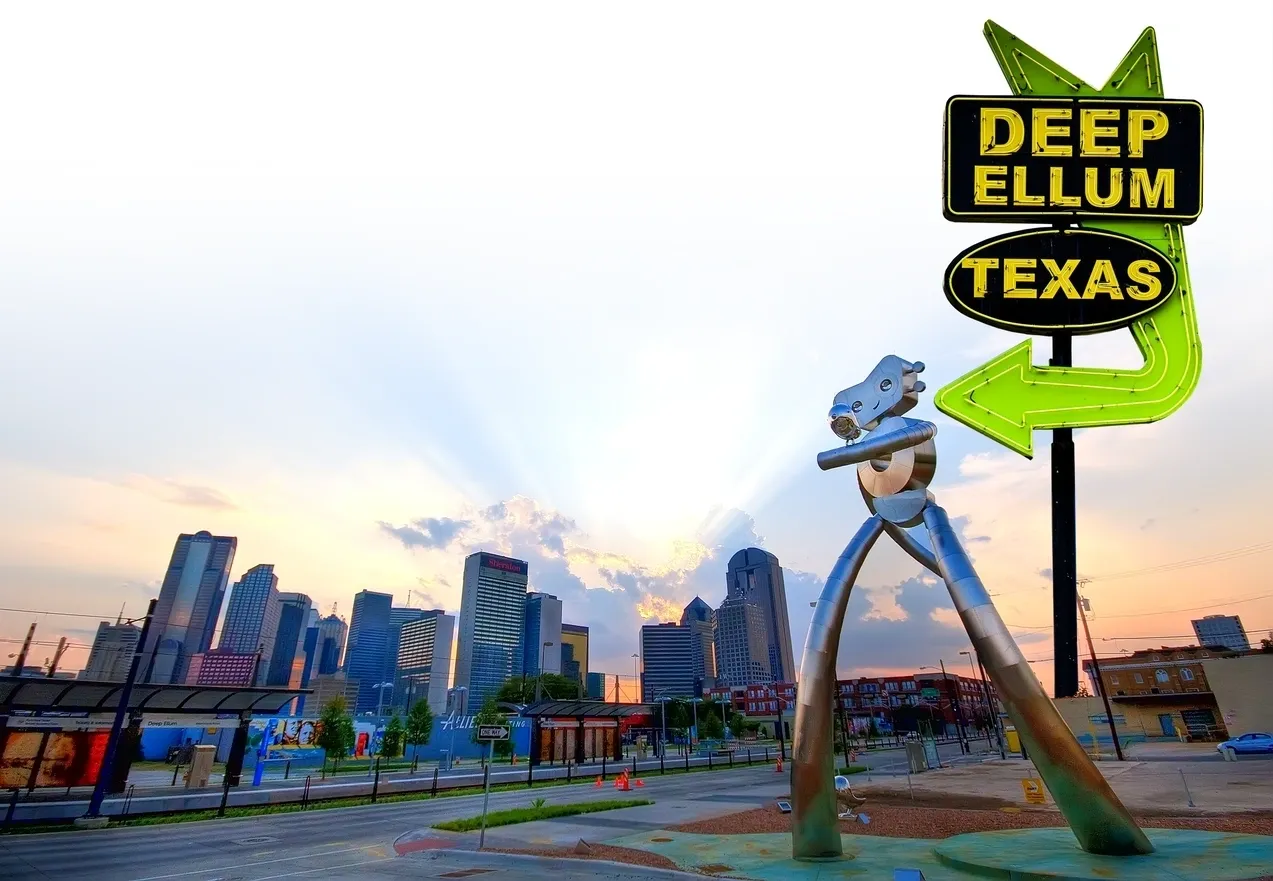
Deep Ellum is less about one famous sign and more about an entire visual environment.
The neighborhood has deep roots in Dallas music history. Visit Dallas notes that Deep Ellum became widely known for blues and jazz, with performers such as Blind Lemon Jefferson, Lead Belly and Bessie Smith associated with its storied music scene.
Today, murals, live-music venues, restaurants, bars and independent businesses continue to give the district a highly recognizable street-level personality.
Walk through Deep Ellum at night and you’ll encounter a mixture of:
- Neon-style signs
- Illuminated storefront signs
- Murals
- Restaurant signage
- Bar signs
- Channel letters
- Window graphics
- Branded interiors
This makes Deep Ellum a useful example of how custom signs in Dallas can contribute to a neighborhood’s character while still helping individual businesses compete for attention.
For businesses that want the colorful glow associated with classic neon, modern LED technology offers another option. Our guide to LED vs. neon signs explains the differences between the two technologies and where each can make sense.
You can also explore why Dallas businesses use custom LED neon signs for logos, feature walls and branded spaces.
AT&T Discovery District Media Wall
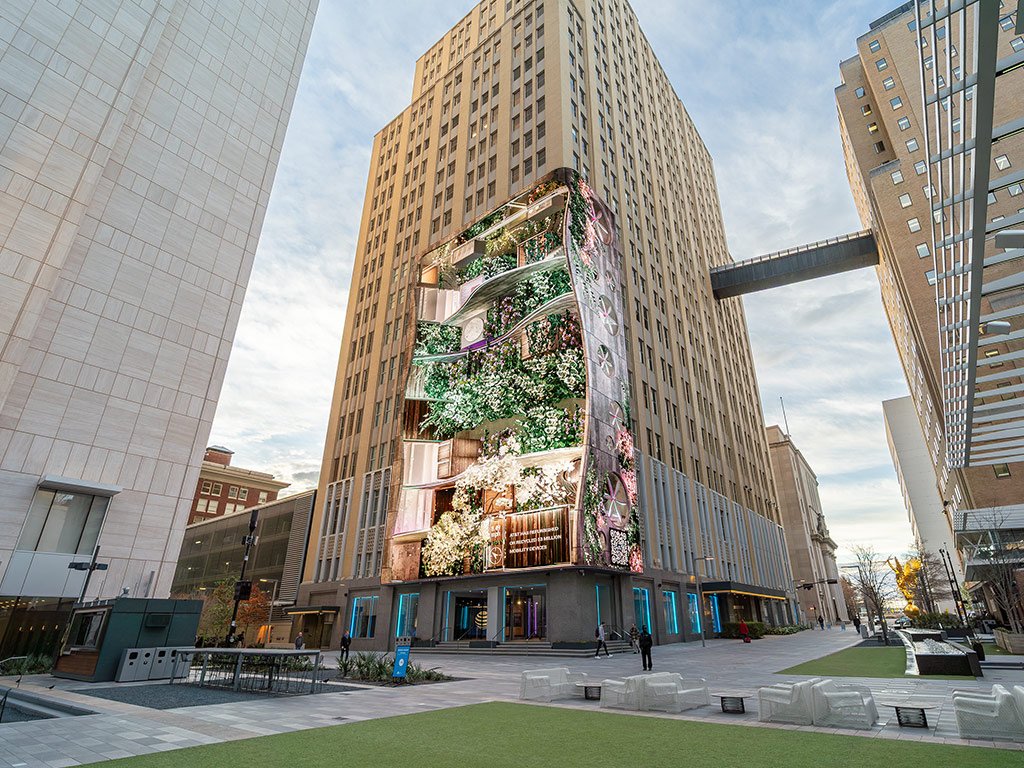
If Pegasus represents historic Dallas signage, the AT&T Discovery District represents the digital end of the spectrum.
The District’s Media Wall is difficult to miss. According to AT&T Discovery District, the display stands 104 feet tall, covers approximately 9,300 square feet, and operates at 6K resolution.
Nearby, The Globe uses 300,000 LEDs as part of an interactive light and sound experience.
The result demonstrates how dramatically digital display technology has expanded what visual communication can do.
A traditional sign usually communicates a relatively fixed message. A digital display can change content throughout the day, display motion graphics, promote events, show video and adapt messaging without replacing the physical sign.
Businesses obviously do not need a 104-foot screen to use the same concept.
Modern LED signs and commercial digital displays can be used for:
- Retail promotions
- Restaurant menus
- Business announcements
- Indoor branding
- Entertainment venues
- Lobbies
- Outdoor advertising
- Changing promotional content
For Dallas businesses considering this technology, the AT&T Discovery District offers a dramatic example of how digital content can become part of a physical environment.
The Adolphus Hotel
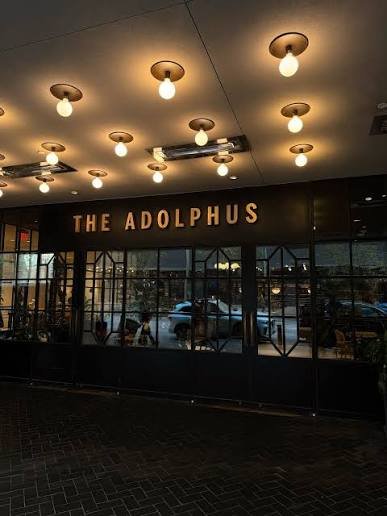
Opened in 1912, The Adolphus has been part of downtown Dallas for more than a century. The hotel’s own historical materials describe it as Dallas’ first luxury hotel and note that the building was modeled after a Beaux-Arts German castle.
Its importance to this list is not based on one enormous illuminated sign. Instead, The Adolphus shows how architecture, building identification and brand presentation can work together.
For hospitality properties in particular, signage has to complement the building.
An oversized or poorly styled sign can feel disconnected from the architecture. The best building signs consider materials, proportions, mounting location, typography, illumination and the surrounding façade.
This is why custom signage should be designed around the property rather than selected as an isolated product.
Bishop Arts District
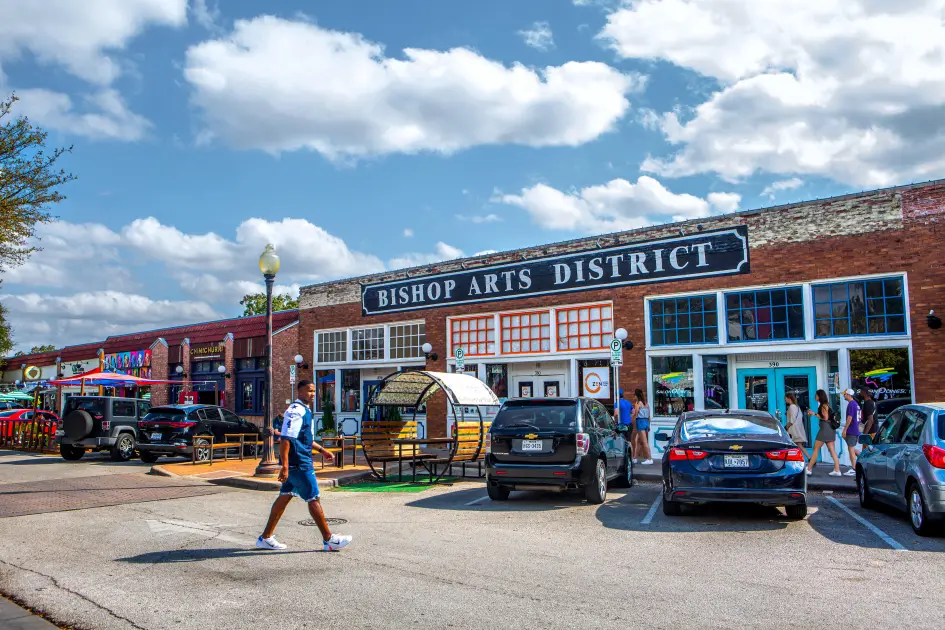
Bishop Arts offers another example of how smaller storefronts can collectively create a memorable neighborhood.
Visit Dallas describes the area as home to boutiques, antique shops and other independent businesses, while its arts coverage highlights murals woven among locally owned shops, restaurants and bars.
This environment is particularly relevant to small-business signage.
Independent businesses usually cannot rely on a huge corporate building or enormous roadside structure. Instead, they build recognition at street level.
That can include:
- Blade signs
- Window graphics
- Hanging signs
- Channel letters
- Awning signs
- LED neon
- Dimensional lettering
- Creative storefront displays
Good outdoor business signage should help a storefront stand out without feeling disconnected from its surroundings.
For neighborhoods with heavy pedestrian traffic, details such as viewing angle matter too. A blade or hanging sign can sometimes be more useful to someone walking down the sidewalk than lettering mounted flat against a façade.
Big Tex and Fair Park
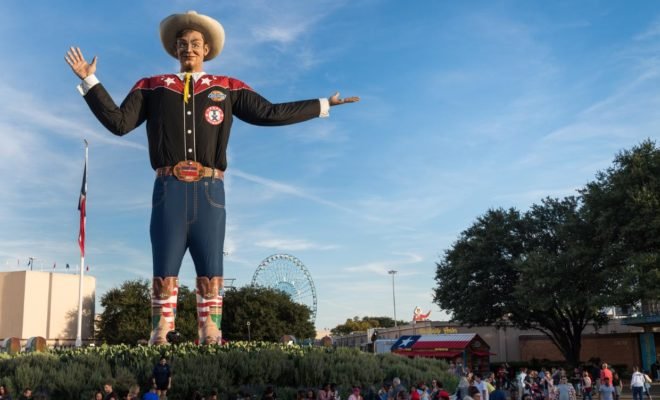
No list of recognizable Dallas-area visual icons would feel complete without Big Tex.
The towering cowboy has served as the official greeter of the State Fair of Texas since his debut in 1952. State Fair materials describe Big Tex as 55 feet tall and note his long-standing role welcoming visitors to Fair Park.
Fair Park itself has major historical significance. It was designated a National Historic Landmark in 1986, according to State Fair materials.
Big Tex is not technically a business sign, of course, but he demonstrates one of the most powerful principles in visual branding: recognizable assets become shorthand for a destination.
People do not need a long explanation when they see Big Tex. The visual itself communicates the place and experience.
Businesses aim for a similar effect at a different scale. A recognizable logo, consistent colors, distinctive storefront and well-designed sign make it easier for customers to remember where they have been and recognize the business again.
What Dallas’ Most Iconic Signs Teach Us About Business Visibility
These landmarks are very different from one another, but several visual principles appear repeatedly.
The Pegasus uses a distinctive symbol and illumination. Reunion Tower uses architectural lighting. The Majestic combines a marquee with historic architecture. Deep Ellum and Bishop Arts demonstrate the importance of street-level visual character. The AT&T Discovery District shows what is possible with large-format digital displays.
The lesson is not that every Dallas business needs a landmark-sized installation.
It is that recognition comes from deliberate visual choices.
For a roadside property, that might mean a monument or pylon sign positioned for approaching traffic. For a retail storefront, it could mean illuminated channel letters. A restaurant may combine exterior signage with custom LED neon inside. An office might depend more heavily on lobby signs, dimensional lettering, ADA signage and wayfinding.
The appropriate sign depends on the building, viewing distance, customer behavior and location.
Discount LED’s commercial signage solutions include channel and dimensional letters, cabinet and awning signs, post and panel signs, monument signs, pylon signs and other interior and exterior applications.
The company’s Dallas sign and lighting project portfolio also provides examples of completed storefront, channel-letter, monument and pole-sign projects across DFW.
Which Type of Sign Is Right for a Dallas Business?
There is no single “best” business sign. The right choice depends on where customers will see it.
Channel letters work particularly well for storefronts and commercial building façades where the business name needs strong daytime and nighttime visibility.
Monument signs are useful at property entrances, business parks, offices and developments where drivers need identification closer to road level.
Pylon signs provide greater height and can make sense for businesses or multi-tenant properties that need to be visible from farther away.
Storefront signs can combine channel letters, cabinet signs, blade signs, window graphics and other formats depending on the property.
LED and digital signs are useful when the content needs to change, whether for promotions, information, menus or other messaging.
Interior signs serve a different purpose by reinforcing the brand and helping visitors navigate once they enter the building.
The broader principle is the same one visible throughout Dallas: the sign should fit the place.
If you’re planning exterior signage, Discount LED’s guide to outdoor signage in Dallas covers monument and pylon signs, storefront and channel letters, blade signs, cabinet signs, post and panel systems and other exterior options.
From Dallas Landmarks to Local Business Signs
Dallas’ visual identity has been built over generations.
Historic neon helped give the city recognizable nighttime landmarks. Architectural lighting transformed buildings into parts of the skyline. Murals and storefront signs helped neighborhoods develop distinctive personalities. Today, digital displays are adding another layer to the city’s visual landscape.
A local business sign operates on a much smaller scale, but the goal is surprisingly similar.
It needs to help people notice, identify and remember a place.
For Dallas business owners, that means considering more than simply putting a name on a wall. Visibility distance, illumination, typography, colors, materials, building architecture and surrounding signs all affect how successfully a sign communicates.
Discount LED designs, fabricates and installs signage for businesses across the Dallas-Fort Worth area, including channel letters, monument and pylon signs, storefront signage, interior signs and LED display solutions. The company’s current website also emphasizes in-house fabrication and a concept-to-installation approach.
If Dallas’ most recognizable landmarks prove anything, it is that a strong visual identity can stay in people’s minds long after they have passed it.
Frequently Asked Questions
The Pegasus sign is one of the strongest candidates. The red flying horse first appeared above the Magnolia Petroleum Building in 1934 and became an enduring symbol of Dallas.
Well-known Dallas landmarks include Reunion Tower, the Pegasus sign, the Majestic Theatre, Big Tex at Fair Park, The Eye and prominent destinations such as the AT&T Discovery District.
Deep Ellum is especially associated with nightlife, music venues, restaurants, murals and visually distinctive storefronts. Bishop Arts is another useful area for seeing independent shops, restaurants, murals and creative street-level branding.
Signs can become recognizable reference points through distinctive design, consistent use, illumination, placement and history. Dallas’ Pegasus is an unusually strong example because what began as corporate identification eventually became associated with the city itself.
Common commercial options include channel letters, monument signs, pylon signs, cabinet signs, storefront signage, dimensional letters, LED signs, interior signs and digital displays. The best choice depends on the building, viewing distance, local requirements and how customers approach the property.